
 Right Angle Gearing
Right angle gearing consists of an input (drive) pinion and an output (driven) gear with perpendicular axes of rotation. The three most common types of right angle gearing used in gearboxes is spiral bevel, worm, and hypoid. Each of these types of gearing have their advantages but come down to a trade-off between the ratio density, or torque capacity, and the mechanical efficiency.
The primary difference between spiral bevel, worm, and hypoid gearing is the position of the input (drive) pinion along the arc of the output (driven) gear. This has a significant impact on available ratios, load-carrying capabilities and mechanical efficiency.
Gearing Terms
Meshing Action
Mechanism for how the teeth of the pinion come into contact and drive the gear. Meshing can be sliding, rolling, or a combination.
Meshing of paired gears with intersecting axes, such as spiral bevel, will have a simple rolling motion with minimal slippage for high efficiency.
Non-intersecting gears, such as worm gears, rotate with high slippage, producing friction and decreasing efficiency.
Tooth Contact Area
Amount of load sharing among teeth. Higher tooth contact area results in higher torque capacity
Backlash
Amount that the space between teeth on one gear exceeds the thickness of the engaging tooth on the other gear. In a gearbox, this will result in motion at the output when the input is held stationary.
Backlash, Wear, and Sliding Action
None of these three types of gears have inherently less backlash.
- Less sliding action means less wear resulting in the backlash increasing less over time.
- For similar precision level, less backlash means more heat which decreases efficiency. For spiral bevel gearing, which already has high efficiency, this is less of an issue. For inefficient worm gearing, this is more of an issue
Types of Right Angle Gearing
Spiral Bevel Gearing
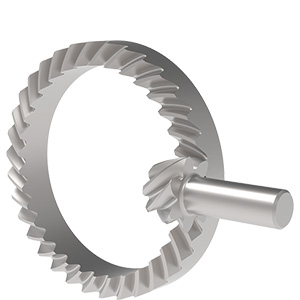
In spiral bevel gearing, the input and output axes intersect. Conventional spiral bevel gearing uses helical teeth. The angled teeth produce a purely rolling meshing action resulting in very high efficiency.
However, it also has a small total tooth
contact area, so its torque capacity is lower compared to other types of right angle gearing.
Single-stage spiral bevel gearing is typically available with 1:1 to 6:1 reduction ratios. Higher ratios can be easily achieved with multiple-stage configurations, but the additional gear stage lowers mechanical efficiency, increases backlash, consumes space and weight, and reduces reliability.
The gear set geometry, along with the low ratios, allow for many output configurations.
Advantage: High efficiency, low ratios, and high configurability for design flexibility
Hypoid Gearing
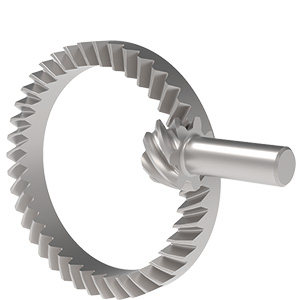
Hypoid gearing is a type of spiral gearing with axes offset from each other, neither inline as with bevel gearing or perpendicular like worm gearing. This design results in a meshing action that is mostly rolling with a small component of sliding.
The tooth contact area is greater than bevel gearing, so its load-carrying capability is greater. Hypoid gearing offers further advantages with typical ratios up to 10:1 (15:1 with GAM Dyna or Dyna-Lite series) in a single stage and low backlash.
Advantage: Combines the space and configuration advantages of worm gearing with the high efficiency of bevel gearing.
Dyna-Lite Series Hypoid Gearboxes
Worm Gearing

Conventional worm gearing uses a straight tooth gear with a spiral tooth pinion and the pinion is perpendicular to the output gear. The meshing action of this design has a high component of sliding action, generating friction, and resulting in the lowest mechanical efficiency.
This design has very high total tooth contact area providing high torque capacity and high speed reduction, typically 5:1 to 60:1. Worm gearing is also subject to wear that requires adjustment to maintain accuracy.
Advantage: High reduction ratio, high torque throughput
Summary
| Feature | Spiral Bevel | Hypoid | Worm |
| Meshing Action | Rolling | Rolling with some sliding | Sliding |
| Pinion Position | Inline | Offset Inline | Perpendicular |
| Maximum Ratio (single stage) | 1:1 to 6:1 | 3:1 to 10:1 (15:1 with GAM) | 5:1 to 60:1 |
| Relative Torque Capacity | Lowest | High | Highest |
| Efficiency | Highest | High | Lowest |
Contact the GAM Team
Have questions? Our team of experts can help! Give us a call at 888-426-7117 or fill out the form below and one of our team members will be in touch shortly.
*Required fields