
Why are planetary gearboxes preferred for servo applications?
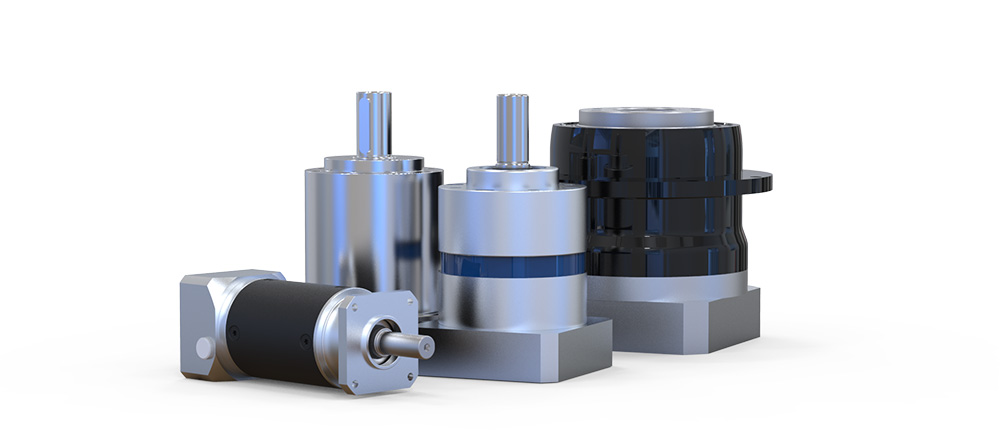
In a servo application — one in which a feedback device is used to control torque, position, or speed of a linear or rotary system — the ratio of the load inertia to the motor inertia is a critical factor in system performance. A lower inertia ratio allows the motor to more precisely control the load and avoid overshoot and oscillations, improving system responsiveness. If the actual inertia of the load cannot be changed, adding a gearbox to the system can reduce the amount of load inertia reflected back to the motor (essentially, making it seem to the motor as if there is less inertia to be moved).
A gearbox reduces the reflected load inertia (inertia the motor “sees”) by the square of the gear ratio, so adding a gearbox can make a significant improvement in the system’s inertia ratio. Gearboxes also multiply the torque from the motor to the load by an amount proportional to the gear ratio, while at the same time lowering the required motor speed by the same amount. In some applications, this means a smaller motor can be used, and the motor can be operated at a higher, more efficient speed.
Inertia Ratio = JL / JM
JL = inertia of load reflected to motor
JM = inertia of motor
JL = [ (JD + JE + JC) / i2 ] + JG
JD = inertia of drive (screw, belt & pulley, or actuator)
JE = inertia of external (moved) mass
JC = inertia of coupling
JG = inertia of gearbox
i = gear ratio
But any gearbox can reduce load inertia, multiply torque, and reduce speed, so why do many servo applications use planetary gearboxes? Because planetary gearboxes do all these things with higher stiffness, less backlash, better efficiency, and lower noise than other gear types.
Planetary gearboxes use three gear types to transmit torque: planetary gears, a sun gear, and a ring gear. The attached motor drives the sun gear, which sits in the center of the gear assembly. Multiple planetary gears engage with both the sun gear and the ring gear, which is stationary and fixed inside the gearbox housing. As the sun gear rotates, it drives the planetary gears to spin on their own axes and revolve around the sun gear. The positions of the planetary gears are set by a carrier, which also incorporates the output shaft.
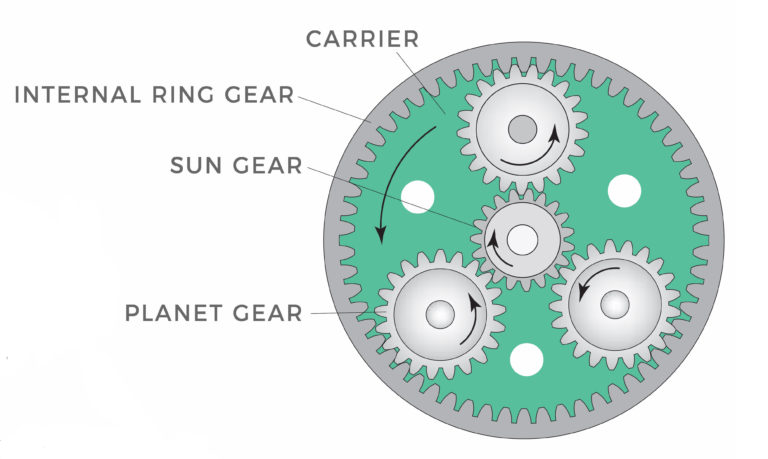
In this arrangement, the load is shared among multiple gear teeth, which gives planetary designs their high stiffness and contributes to low backlash — as low as 1 to 2 arcminutes in some designs. High stiffness is also important for applications that require frequent start-stop cycles or changes in rotational direction.
Planetary designs are compact, providing high reduction ratios in a small overall package. This compact design also means they have low inertia, which is especially beneficial in servo applications because the gearbox inertia adds directly to the load inertia that the motor must balance. And although planetary gearboxes, like other gearbox designs, can be lubricated with either grease or oil, most are lubricated by the manufacturer with grease and don’t require re-lubrication or maintenance for the life of the gearbox.
Single-stage planetary gearboxes (as described above) can typically provide reduction ratios as low as 3:1 or as high as 10:1. Multi-stage gearboxes provide higher ratios by incorporating two or three planetary stages in a serial arrangement. To accomplish this, the length of the outer ring gear is increased, and the carrier of the first planetary stage drives the sun gear of the next stage. Because they’re connected in a serial arrangement, the reductions of the individual stages are multiplied to get the final output reduction. For example, a multi-stage gearbox that incorporates a 5:1 stage and a 3:1 stage will have an output ratio of 15:1. Multi-stage designs provide an even better torque-to-size ratio than standard single-stage designs, but at the expense of efficiency.
Planetary gearboxes can use either spur or helical gears. Spur gears provide higher torque ratings, but helical gears have a higher contact ratio (the number of teeth in mesh at any given time). This higher contact ratio allows helical designs to operate with less noise, higher stiffness, and less backlash, making helical planetary gearboxes the preferred choice for servo applications.
GAM Planetary Gearboxes
Learn more about GAM's Planetary Gearboxes
SPH Inline Helical
Helical planetary gearing provides the highest precision for demanding applications
Learn More
EPL Inline Planetary
Highly configurable and customizable inline with shaft, flange or hollow outputs
Learn More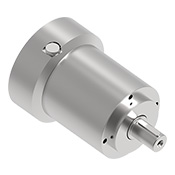
SSP Stainless Steel Inline Planetary
Stainless steel inline for food, medical, or sanitary applications
Learn More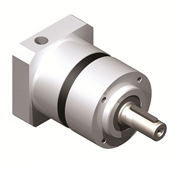
PE Inline Planetary
The GAM PE series is a great inline planetary gearbox, ideal for most servo and stepper applications.
Learn More